



How Grain Futures Markets Support Physical Hedging
Learn how grain futures support physical hedging through short and long hedges, basis, convergence, cross-hedging, margin and a practical wheat example.
- Grain futures market
- Grain futures hedging
- Physical hedging
- Basis risk
Grain futures markets support physical hedging by allowing businesses that own grain, expect to produce it or need to buy it later to take an opposing position in the futures market. An adverse price move in the physical market can then be partly offset by a gain on the futures position. A farmer holding a crop sells futures to protect against falling prices; a mill or feed manufacturer that will need grain buys futures to protect against rising prices. In both cases, the aim is to replace outright price risk with basis risk, which if often smaller and less volatile depending on the local cash market dynamics.
This article explains how short and long hedges work, how basis and convergence affect the result, when cross-hedging is used, and what businesses need to consider after placing a hedge.
The core hedging mechanism: an opposite position
Hedging involves taking a futures position that is opposite to the physical, or cash, exposure. Cash and futures prices for the same grain tend to move broadly in the same direction because they respond to many of the same supply and demand factors. This allows a gain in one market to offset at least part of a loss in the other.
Physical exposure | Main price risk | Futures hedge | Hedge normally closed when |
|---|---|---|---|
Producer or elevator holding or expecting to sell grain | Prices fall | Short hedge: sell futures | The physical grain is priced or sold |
Processor, feedlot or importer expecting to buy grain | Prices rise | Long hedge: buy futures | The physical grain is priced or purchased |
The rule of thumb: if your eventual action is to sell in the cash market, hedge today by selling futures; if your eventual action is to buy in the cash market, hedge today by buying futures.
The short hedge, worked through
Say it's March and a wheat producer plans to sell to the local elevator in mid-June. July wheat futures are trading at $6.50 per bushel, and the cash price in the producer's area in mid-June is normally about 35 cents under the July futures price, a basis of −$0.35. The producer sells July futures now, aiming for an approximate price of $6.15 per bushel ($6.50 futures minus the 35-cent basis).
If the producer expects to sell 10,000 bushels, the hedge would represent two standard 5,000 bushel CBOT Chicago Wheat futures contracts.
If futures fall to $6.00 by June and the basis holds at 35 cents under, the producer sells cash wheat at $5.65 and buys back the futures position for a 50 cent gain. The net selling price is $6.15 before transaction costs, matching the original target because the basis was unchanged. Once the quantity and timing of the futures hedge are aligned with the physical sale, the main source of difference from the target is basis:
Final basis | Cash price when futures are $6.00 | Futures gain | Net selling price |
|---|---|---|---|
$0.30 under | $5.70 | $0.50 | $6.20 |
$0.35 under | $5.65 | $0.50 | $6.15 |
$0.40 under | $5.60 | $0.50 | $6.10 |
The long hedge, worked through
A commodities buyer uses the same mechanism in reverse. Take a corn importer expecting to buy in June. In March, CBOT July corn futures are trading at $3.93 per bushel. The importer buys July futures to protect the futures component of the eventual purchase price.
By June 14, assume for simplicity that both the local cash price and July futures have fallen to $3.63. The importer buys the physical corn at the lower cash price but closes the long futures position at a loss of $0.30 per bushel. Before transaction costs, the futures loss offsets the reduction in the cash price, producing a net purchase cost of $3.93. If both prices had risen by the same amount, the higher cash cost would have been offset by a futures gain. A hedge is intended to make the commercial result more predictable, not to produce a windfall. In practice, the final cost will also reflect basis and execution costs.
Grain futures hedging example: a 5,000-tonne wheat position
This anonymised example took place in June 2026, leading into harvest for the 2026/27 marketing year. A grain trader had an opportunity to sell 5,000 tonnes of feed wheat FCA Ravenna at €218 per tonne. The Ravenna cash price had fallen from more than €225 per tonne during the previous two weeks, but the trader did not want to lose the customer.
Because the wheat still needed to be purchased, the sale left the trader exposed to a recovery in physical prices. To manage that risk, the trader bought December Euronext Milling Wheat futures at €213.93 per tonne. With the Ravenna cash price at €218, the starting basis was €4.07 over futures.
Each futures contract represented 50 tonnes, so the trader bought 100 contracts to cover the 5,000-tonne physical position.
Futures fell through June and into July. As the position was marked to market, the trader had to lodge additional funds to maintain it. Prices later rose as the market responded to smaller-than-expected European crops and concerns about Russian and Ukrainian wheat supplies in the export market.
When the hedge was closed, the Ravenna cash price had risen to €230 per tonne and December futures had reached €235.38.
Position | Entry | Exit | Result |
Physical wheat | Sold at €218/t | Purchased at €230/t | −€60,000 |
December wheat futures | Bought at €213.93/t | Sold at €235.38/t | +€107,250 |
Basis | +€4.07/t | −€5.38/t | Weakened by €9.45/t |
Combined physical and futures result | +€47,250 before fees | ||
Trading, clearing and exchange fees | −€1,000 | ||
Result after fees | +€46,250 |
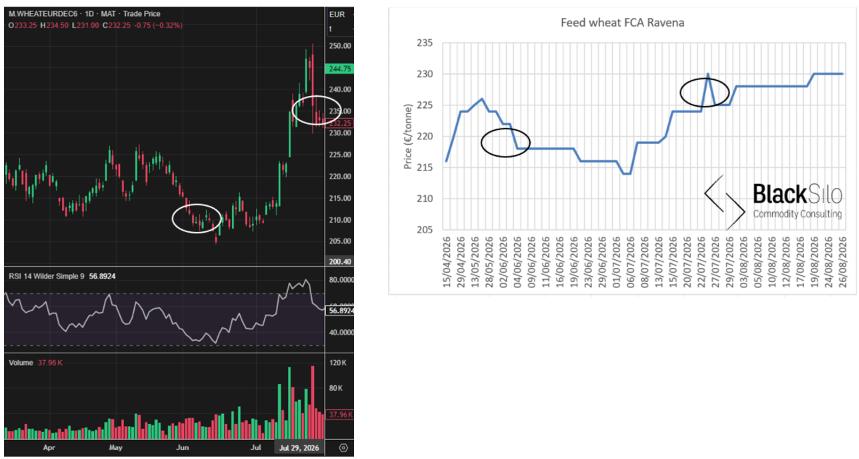
The fees were equivalent to €0.20 per tonne. The hedge produced a positive result because the basis weakened by €9.45 per tonne: the futures gain was greater than the increase in the cost of purchasing the physical wheat.
The example also shows why margin planning matters. Although the hedge ultimately generated a gain, the trader still needed additional cash when futures fell through June and into July.
Black Silo helped the client identify a suitable clearing partner and negotiate terms, understand the available hedging tools before trading, estimate potential margin requirements and monitor the position throughout its life using its DELIVER process, an iterative framework Black Silo developed to follow and manage hedges from entry to close. The support also included physical cash prices for marking the physical exposure and regular updates on the futures position. Black Silo can also price and structure options hedges, drawing on decades of risk-management experience, including professional options trading.
Basis risk in grain futures hedging
A futures hedge establishes the futures-price component of a transaction. It does not lock in the local cash price, because local cash prices reflect the futures price adjusted for freight, handling, storage, quality, and local supply and demand, the basis. Basis is calculated as:
Basis = Cash price − Futures price
A negative basis ("under") means cash trades below futures; a positive basis ("over") means cash trades above futures. Selling futures in a short hedge protects the futures component of the price and leaves the local basis unpriced. The final value of the grain therefore continues to move with local basis conditions even though much of the outright futures-price risk has been reduced. Basis is often less volatile than the full commodity price, so exchanging flat-price risk for basis risk can materially reduce overall exposure without eliminating it. A short hedger benefits when basis strengthens, meaning cash rises relative to futures, and is hurt when it weakens. A long hedger benefits from the opposite movement: a weakening basis lowers the net purchase price.
Basis often follows local and seasonal patterns. In many markets, it strengthens after harvest as nearby supplies are absorbed, although storage capacity, transport constraints, quality and local demand can produce a different pattern. Hedgers who track years of local basis history alongside current physical cash prices are better placed to form realistic expectations for a particular location and delivery period.
Why convergence matters in grain futures markets
Convergence is the tendency of eligible cash prices and futures prices to come together as a contract approaches delivery. The possibility of physical delivery supports that relationship. If a gap remains large enough to cover storage, transport, financing, quality and execution costs, commercial participants may be able to trade the difference. Those transactions help bring the two prices back into line. Persistent nonconvergence weakens the relationship between a futures hedge and the eventual cash transaction.
Research published in the Journal of Commodity Markets examined short hedge performance during the 2005–2010 period of nonconvergence in U.S. wheat, corn and soybean markets. Wheat was the clearest problem. The correlation between wheat spot and futures price changes fell to about 0.15, and the minimum variance hedge did not consistently reduce profit variance relative to remaining unhedged. Corn and soybean correlations remained much higher, so their hedging performance was less affected. The authors report that wheat hedge performance improved in the post-nonconvergence period after CME introduced seasonal storage rates and then the variable storage rate mechanism.
≈0.15 correlation: During the period examined, the relationship between wheat spot and futures price changes weakened substantially, reducing hedge effectiveness.
Hedgers therefore need a futures contract that maintains a dependable relationship with the relevant cash market. Convergence is central to that relationship, but it isn't guaranteed. Hedgers should know a contract's convergence history and delivery mechanics before relying on it.
When there's no direct futures market: the cross-hedging problem
Hedging effectiveness also depends on whether a dedicated futures contract exists for the commodity being hedged. With no actively traded US barley futures contract, producers, elevators and feed users may use CBOT corn futures as a cross-hedge for feed barley because both commodities compete in feed markets.
Cross-hedging introduces additional risk because barley cannot be delivered against a corn futures contract, and barley cash prices are not required to converge with corn futures. The barley–corn price relationship can change with regional production, feed demand, quality, freight and trade conditions. The relationship may be weaker for malting barley, whose price also reflects specifications and premiums that corn futures do not capture.
Research published in the Journal of Political Economy provides the theoretical framework for cross-hedging. It explains how the appropriate cash and futures positions depend on price expectations, production conditions and the futures markets available to the hedger. The hedge ratio therefore needs to reflect the observed relationship between the relevant barley cash price and corn futures. These prices will not always move by the same amount.
Cross-hedging does not remove price risk: it adds the risk that the physical commodity and the selected futures contract move differently. For feed barley hedged with corn futures, this cross-commodity risk sits alongside the usual locational basis risk.
How grain futures markets support physical trade
Beyond the mechanics of any single hedge, grain futures markets support the physical trade in ways that show up even for participants who never place a hedge themselves:
- Price discovery: Futures prices bring together the expectations of buyers and sellers responding to weather, input costs and global demand, giving the physical market a transparent reference price for local bids and offers.
- Standardization: The exchange specifies key terms such as contract quantity, grade, delivery month, delivery locations and settlement rules. Common terms allow many participants to trade the same instrument efficiently, although the contract may not match every hedger's physical exposure exactly.
- Risk transfer and liquidity: Speculators, market makers and other commercial participants can take the opposite side of hedging transactions. Their activity adds liquidity and helps hedgers enter, adjust and close positions, although liquidity varies by contract and month.
- A settlement mechanism most participants never use: Most futures positions are closed through an offsetting trade rather than carried into delivery. The possibility of physical delivery helps maintain the relationship between futures and eligible cash prices even when few positions reach settlement.
What actually happens once a hedge is placed
The hedge starts with selecting a futures contract that has a reliable price relationship with the physical grain. The contract month should be close to the expected pricing date, and the futures quantity should match the physical exposure as closely as practical. If the expected volume or timing changes, the position may need to be adjusted or rolled. It is normally closed when the corresponding physical transaction is priced.
Maintaining a futures position requires posting margin, which acts as a performance bond. The position is marked to market daily. If the market moves against it, funds are debited from the account; if it moves favourably, gains are credited. For a producer holding a short hedge, a futures loss caused by rising prices is generally offset by an increase in the value of the physical grain still held. The margin call must nevertheless be funded before that physical value is realised through a later sale. A margin call can create a short-term funding need even when the hedge is working as intended. The hedger may have to fund the futures loss before receiving the offsetting benefit from the physical transaction.
Conclusion
Grain futures markets allow producers, traders and processors to reduce their exposure to adverse price movements in the physical market. A well-matched hedge can make the eventual selling or purchase price more predictable, but it does not remove basis risk, contract mismatch, margin requirements or transaction costs. The outcome still depends on choosing the appropriate contract, quantity and delivery month, and then monitoring the relationship between futures and the relevant cash market.
That physical market context remains important throughout the life of the hedge. The Black Silo Platform brings directly sourced cash prices together with supply and demand data, market news and Fryers Reports, helping commercial grain and oilseed teams assess futures alongside the physical markets they are hedging.
FAQ
Does hedging guarantee a better price than not hedging?
No. A hedge establishes an approximate price level in advance; it protects against an unfavourable move but also gives up the benefit of a favourable one. The goal is predictability, not maximising the outcome in hindsight.
Why would a hedger end up worse off than expected?
The final result can differ because basis, quantity, timing or transaction costs were different from the assumptions used when the hedge was placed. Contract mismatch and poor convergence can also reduce hedge effectiveness.
Can you hedge a commodity that has no futures contract?
A business may use a correlated futures contract as a cross-hedge. Feed barley, for example, may be cross-hedged with corn futures where the two prices have a sufficiently stable relationship. Other tools, including physical forward contracts, may also be available. A cross-hedge carries additional risk because the physical commodity and the selected futures contract are not required to converge.
Do most hedgers take delivery of grain through their futures position?
No. Most futures positions are offset, or closed with an opposite trade, before the delivery period. Hedgers normally handle the physical transaction separately in the cash market. The delivery mechanism still matters because it helps connect futures prices with the eligible physical market.
What's the difference between hedging and speculating in the same futures market?
A hedger uses a futures position to reduce an identifiable physical exposure, so gains and losses in the two markets may offset each other. A speculator takes futures exposure without an offsetting physical position and seeks to profit from the market move.

